
Finding a coding school for kids isn't hard. A quick Google search gives you dozens of options. But how do you actually know which one teaches well — and which one just has a good-looking website?
It's about building the foundation for your child to think logically, solve problems, and be ready for whatever career the future brings. Here are five things worth asking before you decide.
📋 A quick checklist before you decide
✅ Teacher has a Computer Science degree or equivalent background
✅ Teaches kids to think — not just to copy
✅ Makes hard content genuinely enjoyable
✅ Curriculum is clearly separated by age group
✅ Child walks away with real work to show for it
A good coding teacher needs two things at once — real knowledge of computer science, and the ability to teach kids. Neither one alone is enough.
Ask directly whether the teacher graduated in Computer Engineering, Computer Science, or a related field. A teacher with a solid foundation can explain complex logic accurately — not just repeat a method they memorised.
But here's what's even harder than knowing the subject: handling problems on the spot.There's no single correct way to write code. One child might solve something one way, the teacher another way, and both get the same output. A good teacher needs to explain what makes each approach stronger or weaker — not just say "follow the answer key." Telling a child there's only one right way is the fastest way to shut down their thinking.
A lot of parents assume that coding for kids means building robots or making games. That's not wrong — but those are outputs, not the actual content.
What matters more is the principles of programming — understanding how code works, thinking in algorithms, understanding syntax, breaking big problems into smaller steps, and recognising patterns that can be reused to solve problems.
A child who genuinely understands these principles can pick up any new coding language on their own, for the rest of their life. A good school doesn't let kids just copy code. It makes sure they understand why that code works.
Coding is genuinely complex. But when it's taught well, kids don't feel that weight at all. The real sign that a school is doing it right isn't just that kids can follow instructions — it's that kids feel proud of what they built themselves.
That sense of pride is what brings them back. When a child is having fun, they want to keep learning on their own. A good school doesn't just teach kids to write code — it makes them fall in love with programming.
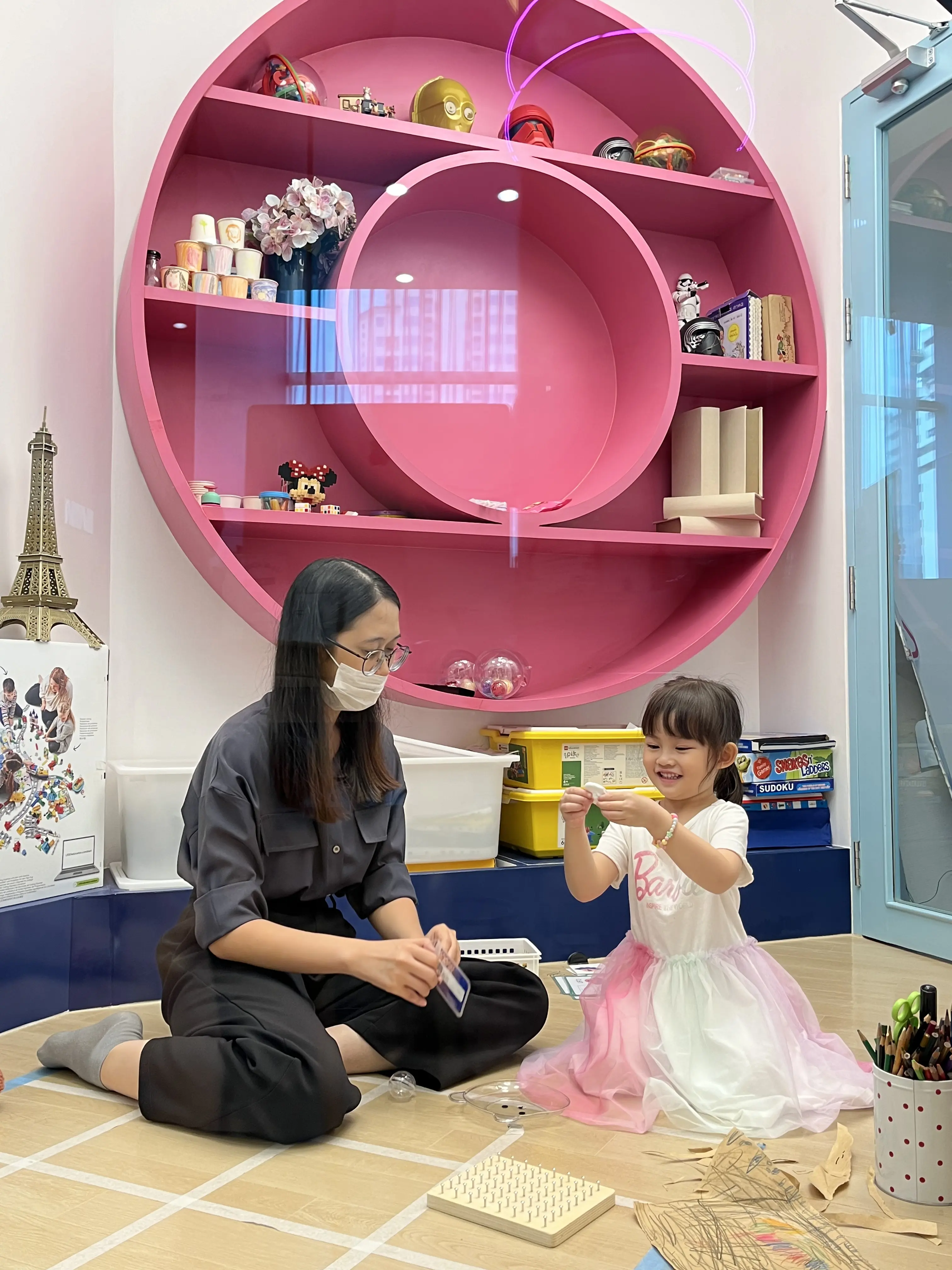
Children develop very differently at each stage. A good curriculum has a clear learning path — it doesn't put every age group in the same class.
Ages 4–5 should start with Design Thinking and unplugged coding, building systematic thinking without a computer. From age 6, kids are ready for Scratch and visual programming — dragging blocks helps them understand logic without needing to type. From age 9 and up, they can move into textbased coding like Python or Roblox game development, where they write real code.
If a coding school tells you they take all ages in the same class, that's a red flag.
A certificate matters a lot less than real work. Your child should leave with a project they built themselves — a game people can actually play, an animation they can share, or a program they can show their friends. That's the proof that they learned something real, not just sat through a class.
The pride a child feels when they see their own program running — that's the best motivation to keep going.
What age can my child start learning to code?
CO-DE Academy welcomes kids from age 4, starting with Design Thinking to build logical thinking skills first.
What's the difference between Scratch and Python — and which one should my child start with?
Scratch is block-based coding, best for kids aged 6 and up. Python is text based and better suited for kids from age 9 who are ready to start writing real code.
What does my child actually get out of learning to code?
Beyond coding itself, kids build problem-solving skills, logical thinking, and creativity — three of the most important skills for the 21st century.
ที่ CO-DE Academy At CO-DE Academy, we offer a free trial class — no cost, no commitment. Parents get to see exactly how we teach. Kids get to build their first real project. Every class is led by teachers with a Computer Science background who understand how children at each age actually learn.
🌟 We don't teach kids to memorize. We teach them to think — and to build. 🌟
📢เริ่มต้นเรียน Coding สำหรับเด็ก 4–18 ปี พร้อมทดลองเรียนฟรี
สมัครเลย